Composure Under Pressure: Why Calm People Make Everyone Else Behave

Composure under pressure is not some monk trick. It’s not “being emotionless.” It’s simply this: you can feel the heat, and still stay usable. You still think. You still decide. You still move like you’re the one holding the remote.
And here’s the part most people miss: your composure doesn’t just affect you. It rewrites the room.
If you walk into tension like you own oxygen, people calm down. If you enter shaky, scanning, needy for certainty, everyone else gets weird too. Not because they hate you. Because humans are mirrors. Most people don’t have their own center. They borrow yours.
So today we’re building one skill: composure under pressure. Not as a “self-help vibe”. As a weapon, a social advantage, and a life cheat code.
The biology of pressure (and why your brain lies to you)
When pressure hits, your body runs an old program: adrenaline, fast breathing, tight chest, tunnel vision. This is useful if you’re being chased by a dog. It’s not useful when you’re negotiating a deal, leading a team, or sitting across from a woman who’s testing you with silence.
The issue isn’t that your body reacts. The issue is that your reaction steals your attention. And attention is your steering wheel.
There’s a classic performance idea often explained as an “inverted U” where a little arousal helps, but too much wrecks execution. Past a certain point, you don’t become “more powerful”. You become sloppy. You choke.
So the goal isn’t to delete pressure. The goal is to keep pressure inside a range where you’re sharp instead of stupid.
The Calm Switch you can hit in 60 seconds
If you only learn one technique, learn this: box breathing.
Inhale 4 seconds. Hold 4. Exhale 4. Hold 4. Repeat.
It’s simple, almost dumb. And that’s why it works. Slow breathing helps nudge your nervous system out of panic mode and back toward control.
Here’s how you use it in real life (not in theory):
- Before you send the risky text.
- Before you walk into the meeting.
- Before you knock on her door.
- Before you speak when you’re angry.
You’re not “calming down.” You’re regaining steering.
And yes, it changes your face too. Your eyes stop darting. Your voice slows. Your presence becomes heavier. People feel it immediately.
The biggest secret: composure is built by exposure, not motivation
People love “tips.” Tips are cute. But composure under pressure is built the same way muscles are built: progressive load.
You don’t become calm by reading calm quotes. You become calm by repeatedly standing inside heat and not running away from it.
Practical examples:
- If you’re scared of rejection: talk to 3 strangers a day for 7 days. No goal. Just reps.
- If you panic during conflict: practice waiting 3 breaths before replying.
- If you freeze under deadlines: simulate pressure. Set a 25-minute timer and ship something imperfect anyway.
- If you get shaky in social settings: go to the place, stay 30 minutes, leave. Repeat. Increase.
There’s a reason athletes practice “game point” scenarios and speakers rehearse in front of small groups first. Familiarity kills panic. You train your brain to stop treating pressure like a tiger.
What “choking” really is (and how to stop it)
Most people choke for two reasons:
- Distraction: “What if I fail?” “What will they think?”
- Over-control: micromanaging skills you normally do naturally.
That second one is brutal. Pressure makes you try to drive your own brain manually. You start thinking about every step. That’s how smooth people become stiff.
A great fix is to give yourself a single cue:
- “Slow.”
- “Shoulders down.”
- “Next step.”
- “One point at a time.”
Simple cue → attention narrows → panic loses oxygen.
This is also why mindfulness actually works when it’s used correctly: it trains your ability to return to the present moment instead of mentally time-traveling into disaster fantasies.
Real calm vs performed calm vs your personality
Now let’s make this crystal clear, because people confuse it:
Real calm = your inner state is stable. You’re not acting. You’re not “trying to be composed.” You simply are.
Performed calm = you look calm, but inside you’re scrambled. This can work short-term, but it leaks. People feel the micro-tension.
Personality style = how you naturally express energy.
And here’s the important part: your personality can be loud, fast, hyper, playful, even chaotic… while your inner state is still calm.
A man can be animated and talkative and still be unshakably grounded inside. That’s not a contradiction. That’s power.
So if your outer personality is intense but your inner state is secure, you don’t need to “act stoic.” You need to stay internally steady.
If your outer performance is calm but your inner state is needy, that’s when the clash happens: you try to look centered while secretly begging the room to validate you.
When those clash, don’t “fix your personality.” Train your inner stability so the outer you becomes honest.
Real-world composure is loud in its silence
People love to talk about “staying calm,” like it’s a personality trait you either inherited or didn’t. But the truth is uglier and better: composure under pressure is usually built through embarrassment, repetition, and a few moments where you almost lose it… then you don’t.
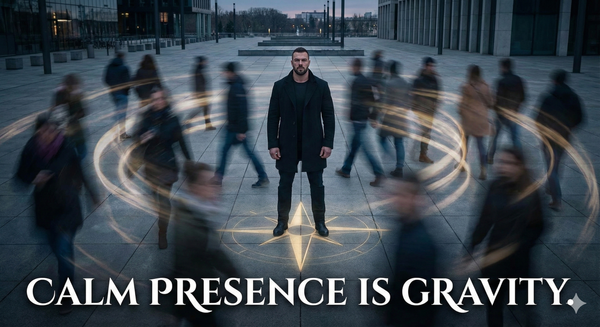
And once you see it in real life, you can’t unsee it: the calm person becomes the center of gravity. Everyone else starts orbiting them. The room follows their breathing, their pace, their decisions.
Federer wasn’t born ice-cold, he trained it like a backhand
People remember Roger Federer as elegance in human form. Smooth. Silent. Effortless. But early Federer wasn’t always that polished “Swiss watch” energy. Even later in his career, he had moments where emotion cracked through, because he’s human.
The real lesson isn’t “never feel anything.” It’s that the great ones learn how to reset. They don’t let one ugly moment write the next ten minutes. They treat pressure like weather: it shows up, it passes, and you keep playing the point.
That’s what composure under pressure looks like in the wild: not some monk floating above emotion, but a performer who can feel heat and still move cleanly.
The All Blacks have a name for it: blue head vs red head
The New Zealand All Blacks made composure so practical they turned it into a color system. A “blue head” is cool, clear, controlled. A “red head” is panic, rushing, emotion driving the steering wheel. They train players to recognize the shift and reset fast—not with philosophy, with cues and team culture.
That’s the part founders, leaders, and even guys navigating dating chaos miss: composure is not only individual. It’s contagious.
When you’re in blue head, people around you calm down because your nervous system is basically saying:
“Relax. We’re fine. I’ve got this.”
When you’re in red head, everyone else starts scanning for danger too.
Same room. Same problem. Different energy. Different outcome.
In business, “grace under pressure” is literally a trust machine
When leaders lose their composure, teams don’t just feel “oh, he’s stressed.” They feel unsafe. They stop speaking up. They stop offering solutions. They start doing politics.
The Rotman School of Management points out that composure (or lack of it) shapes how teams respond in high-pressure situations—and that calm leaders can create the conditions for better decisions and problem-solving.
This is why calm isn’t passive. Calm is power.
Not because it “controls outcomes”; but because it keeps your brain online long enough to make the clean move while everyone else is emotional gambling.
If you want the shortcut: steal the pattern
Across sports, elite teams, and crisis leadership, the pattern is the same:
- They notice the spike early (before it becomes a spiral)
- They reset with something physical (breath, cue, ritual, pace)
- They narrow focus to the next solvable step
- They don’t perform calm—they return to it
Composure under pressure isn’t being quiet. It’s being unmoved internally while staying fully active externally.
A simple training plan for the next 14 days
No journaling. No over-analysis. Just training.
Daily (7 minutes)
- 2 minutes box breathing (4-4-4-4). Harvard Health
- 3 minutes pressure simulation: do something slightly uncomfortable on purpose
- send the message you’re delaying
- make the ask
- post the thing
- 2 minutes reset walk: move your body, loosen shoulders, slow your eyes
Twice per week (real exposure)
Pick one:
- Go to a social setting alone and stay 45 minutes.
- Have one direct conversation you’ve been avoiding.
- Do a hard workout where your brain begs you to quit, then finish anyway.
Rule
When stress spikes, you don’t “solve life.” You return to:
breath → cue word → next step
That’s it. That’s the whole engine.
Quick FAQs
Does composure mean I should react late to everything?
No. It means you choose timing instead of being hijacked by urgency.
What if I’m naturally emotional?
Great. Emotional range isn’t the problem. Lack of control is. You can be intense and still internally calm.
Closing: your calm is a social force
Here’s what I want you to remember: composure under pressure is not just a personal skill. It’s a gravitational force.
When you stay centered, people behave differently around you. Not because you manipulated them. Because you set the emotional weather.
So don’t wait to “feel ready.” Train it the way fighters train. Breathe. Expose. Repeat. Then watch how fast your life stops feeling like it’s happening to you.